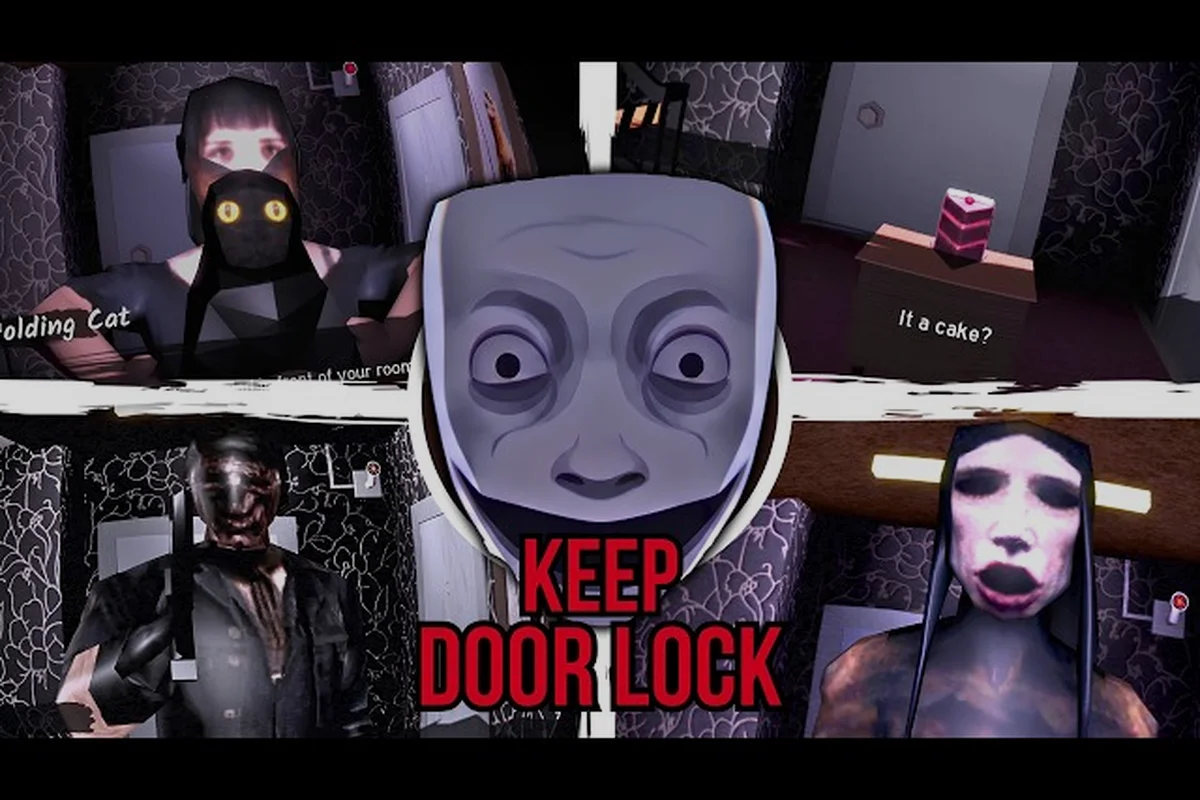
The hotel hallway hums under fluorescent lights, and the first knock comes sooner than you expect. Keep the door locked step by step is the only way to survive the night, because every visitor hides a tell, and one wrong unlock ends your shift permanently. This guide breaks the entire night into a clear sequence so you can trust your camera feed, read each guest, and stay alive until sunrise.
Your First Walkthrough: Core Loop Basics
Every night in this Roblox horror experience follows the same rhythm: a knock, a camera check, a decision. The game launched on May 28, 2026, by developer Hotel Room Services (KivC), and it has already pulled in over 4.3 million visits with more than 10,000 players online at peak hours. That popularity makes sense, because the tension comes from a deceptively simple setup: you sit alone in a hotel room after midnight, strangers knock, and some of them are lying.
Your workstation has three critical tools that form the backbone of any keep the door locked walkthrough: the door panel, the repair kit, and the flashlight. The panel lets you toggle locks quickly, but each use drains power, so time your clicks between monster phases. The repair kit patches weak points, while the flashlight reveals hidden hazards in dark hallways—players often prioritize the panel first to survive early rounds.
-
The monitor lets you cycle through hallway cameras, so you can see who is waiting before you touch the lock.
-
The night vision toggle switches your view when the hallway lights flicker or go dark, which happens frequently after 2 AM.
-
The lock toggle on the door is your only way to let someone in or keep them out, and every use carries weight.
The first knock usually arrives early in the night, often within the first few minutes of your shift. Checking the camera feed before touching the door is the single most important habit you can build, because the game punishes impulsive decisions with a jumpscare and an immediate game over. Safe visitors follow logical stories that match the room, while anomalies contradict themselves or repeat phrases that feel slightly off.
Your shift lasts from midnight until 6 AM, and each hour brings a new wave of visitors. The pacing accelerates as the night progresses, which means your early decisions matter less than your ability to stay consistent when fatigue sets in. The game tracks your mistakes silently, so a single wrong unlock at 5 AM costs you the entire run, even if you handled the first five hours perfectly.
Your Station Setup: Controls, Monitor, and Lock
Before the first knock echoes through your room, you need to understand exactly how your tools work. The controls are simple enough to learn in thirty seconds, but mastering the flow between monitor, night vision, and lock takes practice. According to community reports, most new players die within the first three in-game hours because they hesitate or fumble the camera switch at the worst possible moment.
The monitor interface shows a single camera feed at a time, and you cycle through multiple hallway angles using the arrow keys or the on-screen buttons. Each camera covers a different stretch of corridor, and some visitors stand just outside the frame, so you should always sweep the full loop before making a call. The night vision toggle becomes essential when the lights cut out, because the standard feed turns into a wall of static.
| Control | Default Key | Primary Use |
|---|---|---|
| Camera Cycle | Left/Right Arrows | Switch between hallway camera feeds |
| Night Vision | N | See visitors when hallway lights are off |
| Lock Toggle | Spacebar | Lock or unlock the hotel room door |
| Interact | E | Read notes, use items, respond to visitors |
Here is the step by step routine you should follow every single time a knock comes: pause at the door, check the peephole, and listen for breathing or footsteps. If the knock is followed by a long silence, stay crouched and wait—rushing to unlock often triggers a jump scare. Veterans recommend counting to five before even touching the handle, as the game punishes impulsive reactions.
-
Pause and breathe — do not rush to the door, because the visitor will wait for you.
-
Cycle all cameras once to locate the person and check if anyone else lurks behind them.
-
Switch to night vision if the feed looks dark or grainy, since details matter more than comfort.
-
Listen carefully to what the visitor says, because the audio carries clues that the visual feed sometimes hides.
-
Decide based on the full picture and toggle the lock only when you are confident.
The camera system rewards patience, and players who rush through the cycle miss critical details like a visitor who shifts between two forms or a shadow that moves independently behind the main figure. The hallway has blind spots, so you should always double-check the camera that covers the stairwell entrance, because anomalies sometimes slip in through that path.
Reading Visitors: Safe Guests Versus Anomalies
The heart of any keep the door locked walkthrough is learning to separate genuine guests from the things that wear their faces. Safe visitors behave like real people: they state a clear reason for being there, their story matches what you can verify through the cameras, and they respond naturally to your hesitation. Anomalies, on the other hand, break the pattern in subtle but detectable ways.
The first tell is repetition. A safe visitor might say, "I forgot my key card, can you let me in?" once, maybe twice if you take too long. An anomaly repeats the exact same phrase with identical intonation, sometimes even mid-sentence, as if the recording loop skips. Community testing suggests that anomalies also tend to stand too still, barely breathing while safe visitors fidget or shift their weight.
The second tell is spatial logic. Safe visitors arrive from the elevator or stairwell and walk toward your door in a straight line. Anomalies sometimes appear in the middle of the hallway without a clear approach path, or they vanish from one camera and reappear on another in a location that makes no sense. If you see a visitor move between cameras in under two seconds, treat that as a red flag.
| Visitor Type | Typical Story | Key Tells | Recommended Action |
|---|---|---|---|
| Lost Guest | Forgot room number or key card | Natural movement, matches camera path | Unlock and let them in |
| Hotel Staff | Claims maintenance or room service | Uniform visible, carries tools | Unlock if story checks out |
| Panicked Stranger | Claims someone is chasing them | Looks behind repeatedly, breathing heavy | Verify the hallway first, then decide |
| Anomaly Mimic | Repeats a safe story verbatim | Frozen stance, identical audio loop | Keep the door locked |
| Shadow Figure | No clear story, just stands there | Distorted face, moves unnaturally | Keep the door locked |
The third tell is environmental consistency. If a visitor claims the hallway is dark but your cameras show full lighting, or if they say they came from the elevator while the camera shows the elevator doors never opened, you have your answer. The game rewards players who cross-reference the visitor's story against what the cameras actually show, which is why the full sweep matters so much.
Safe visitors follow logical stories that match the room, and anomalies contradict themselves in ways that become obvious once you know what to look for. Your goal is never to guess; it is to verify, and every unlocked door should feel like a decision backed by evidence rather than a coin flip.
Night Progression: A Step by Step Hourly Breakdown
The night unfolds in six distinct hours, and each one introduces new challenges that test your ability to apply the basics under pressure. This keep the door locked step by step breakdown covers what to expect as the clock ticks toward dawn, based on community reports and verified gameplay footage.
Midnight to 1 AM: The Calm Before
The first hour is gentle by design, giving you time to settle into the routine. You will get one or two visitors, both of whom are usually safe, and the cameras work perfectly. Use this hour to establish your rhythm, because the habits you build here will carry you through the harder hours. Check every camera, listen to every word, and never let the slow pace lull you into complacency.
1 AM to 3 AM: The Pressure Builds
Visitors arrive more frequently, and the first anomalies start appearing. The hallway lights begin to flicker, forcing you to rely on night vision more often. This is where most new players make their first fatal mistake, because they assume the early safe visitors set a pattern. They do not, and the game punishes that assumption with a mimic that copies the exact story of the guest you let in ten minutes earlier.
3 AM to 5 AM: The Gauntlet
This is the hardest stretch of the night. Visitors come in waves, sometimes two or three in quick succession, and the anomalies become more aggressive in their mimicry. The cameras also start glitching, with static bursts that obscure the feed at the worst possible moments. Your night vision toggle becomes your best friend here, because it cuts through most of the visual noise and reveals the true form of anything standing in the hallway.
| Hour | Visitor Count | Anomaly Risk | Special Conditions |
|---|---|---|---|
| Midnight - 1 AM | 1-2 | Low | Clean camera feeds |
| 1 AM - 2 AM | 2-3 | Medium | Occasional light flickers |
| 2 AM - 3 AM | 3-4 | Medium-High | Night vision required more often |
| 3 AM - 4 AM | 4-5 | High | Camera static bursts |
| 4 AM - 5 AM | 5-6 | Very High | Multiple visitors in quick succession |
| 5 AM - 6 AM | 3-4 | High | Final push before sunrise |
5 AM to 6 AM: The Final Stretch
The last hour feels like a victory lap, but it is actually the most dangerous trap in the game. Anomalies at this hour use the most convincing mimicry, often repeating stories that worked earlier in the night, because they know you are tired and eager to finish. The sun starts creeping through the window blinds, and the hallway cameras flicker between day and night modes, creating visual confusion. Stay locked in until the clock hits 6 AM, because the game does not celebrate early.
Advanced Survival Tips: Keeping the Door Locked Through the Worst Nights
Once you understand the basics, you can start layering in advanced techniques that separate survivors from statistics. These strategies come from experienced players who have tested the limits of the game's logic, and they will help you push through the hardest nights without losing your composure.
Trust the audio over the visual feed. Anomalies can distort their appearance, and the camera static gives them cover, but their voices crack in specific ways that careful listeners catch. Safe visitors speak with natural pauses and hesitation, while anomalies deliver lines with robotic precision. Put on headphones if you can, because the difference is often subtle enough to miss on laptop speakers.
Keep a mental ledger of every visitor you have seen. If a guest claims to be a hotel employee, but you already let a staff member in two hours ago, the story becomes suspicious. The game does not explicitly track this for you, but anomalies sometimes slip by recycling stories that should no longer make sense. Your memory is a weapon, and players who actively recall previous visitors catch more mimics than those who react to each knock in isolation.
Learn to trust your gut when the evidence is ambiguous. Sometimes the cameras glitch at the exact moment you need them, and the visitor's story checks out on every level, but something still feels wrong. According to community reports, that feeling is often correct, because the game's anomalies are designed to push the boundaries of plausible behavior. If you cannot find a single concrete flaw but your instincts scream danger, the safer play is to keep the door locked and accept the lost interaction.
For players who want to refine their early decisions, the Keep the Door Locked how to start guide covers the opening minutes in detail, while the beginner tips collection offers additional strategies for surviving your first few nights. If you prefer a broader overview of the game's systems, the full walkthrough breaks down every mechanic in depth.
Mistakes in the First Hours and Recovery
Every player dies in this game, but most deaths come from a handful of predictable errors that you can eliminate with awareness. The most common mistake is unlocking before checking the cameras, which is essentially a coin flip that favors the house. The second most common is checking only one camera, assuming the visitor is alone, when the game frequently sends anomalies with backup that lurks just outside the frame.
Another frequent killer is overconfidence after a streak of safe visitors. Players who correctly identify five safe guests in a row start moving faster, assuming they have cracked the pattern. The game punishes this complacency by sending an anomaly that mimics one of the earlier safe visitors almost perfectly. Treat every knock as a fresh investigation, even if the last ten guests were harmless.
The night vision toggle is underused by new players, and it costs them dearly. Many deaths happen in dark hallways where a visitor's true form is barely visible in the standard feed. Flipping to night vision takes less than a second, and it frequently reveals the difference between a human face and something that merely wears one.
If you find yourself dying at the same hour repeatedly, keep the door locked more often and study what the anomaly looked like on the camera before you made your choice. Every death is a lesson, and the players who survive the night are the ones who treat each run as a learning opportunity rather than a frustration.
Frequently Asked Questions
What is the first thing I should do when I hear a knock?
Check the camera feed immediately, and never touch the lock toggle until you have cycled through every angle. The first knock usually comes early in the night, and safe visitors will wait patiently while you verify their story against what the cameras show.
How do I tell the difference between a safe visitor and an anomaly?
Safe visitors follow logical stories that match the room, while anomalies contradict themselves or repeat phrases with robotic precision. Check for spatial logic, environmental consistency, and audio tells. If the visitor says they came from the elevator but the camera shows the elevator never opened, keep the door locked.
Does night vision actually help spot anomalies?
Yes, night vision cuts through the static and reveals details that the standard feed hides, especially when the hallway lights are flickering or off. Many anomalies appear more distorted under night vision, making them easier to identify before you make a decision.
How long does a full night last in real time?
A full night runs from midnight to 6 AM in-game time, which translates to roughly 15-20 minutes of real time depending on how long you take with each visitor. The pacing accelerates in the middle hours, so expect more frequent knocks between 3 AM and 5 AM.
What happens if I unlock the door for an anomaly?
Unlocking the door for an anomaly triggers a jumpscare and instantly ends your run, returning you to the start screen. There is no second chance, so verifying every visitor before touching the lock is critical. This makes careful camera checks your only defense against a fatal mistake.