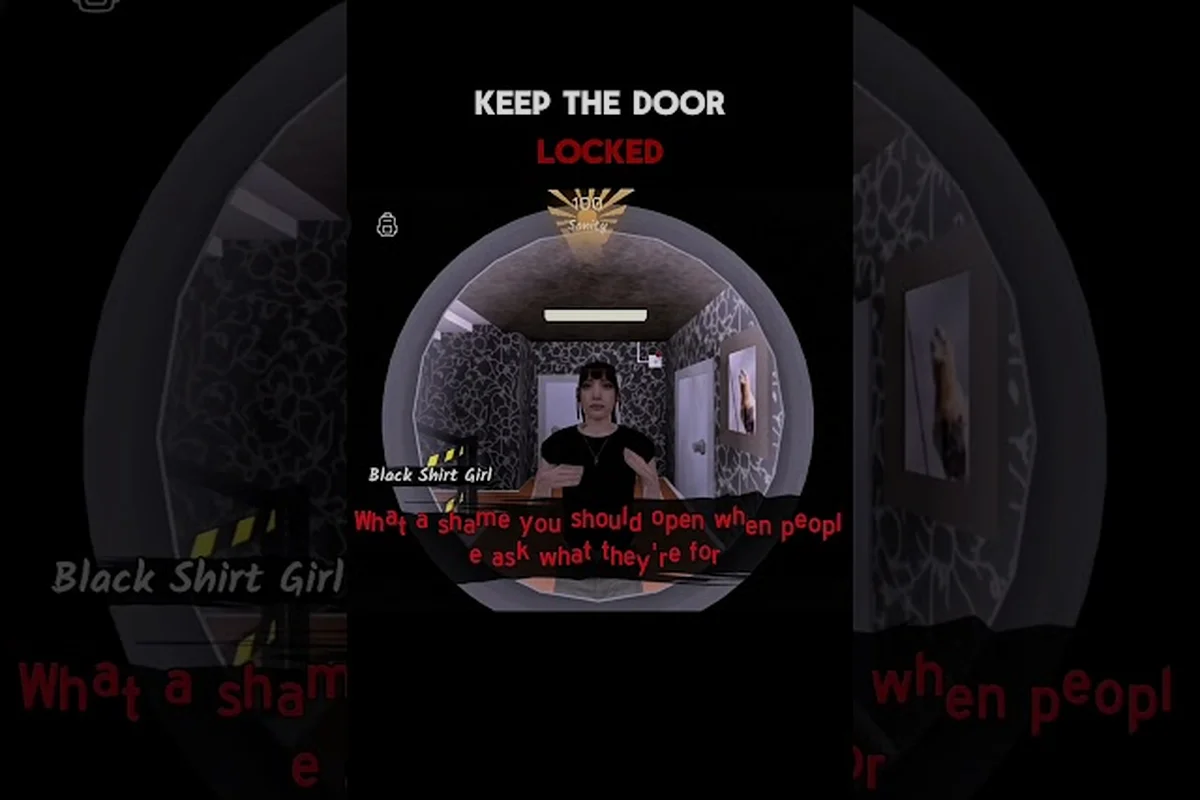
The hotel hallway is dark, the clock reads 2:47 AM, and someone is knocking. Every visitor claims to need help, but the Keep the Door Locked rulebook exists for one reason: some of them are lying. Since its launch on May 28, 2026, this Roblox horror experience has drawn over 4.3 million visits, and the players who survive their shifts are the ones who learn to keep the door locked follow the rules exactly as written. Your sanity meter, your room key, and your life all depend on how strictly you obey the protocol.
The Core Rulebook: What the Keep the Door Locked Rules Actually Say
The game places you alone in a hotel room after midnight, with only a camera monitor and a door intercom between you and the strangers outside. The Keep the Door Locked rules are simple to read but brutal to execute under pressure, because every visitor sounds desperate and every knock feels urgent. The developer, Hotel Room Services (KivC), designed the experience around a single tension: your instinct to help versus the rules that keep you alive.
According to community data gathered from player reports and verified gameplay footage, the fundamental protocol breaks down into five non-negotiable commands: lock the door, stay silent, hide in the closet, avoid the window, and never open for anyone. These commands are critical because each breach triggers a distinct killer response, and veterans note that even a single missed step often forces a restart.
-
Check the cameras before you even touch the door handle — the monitor is your only window into what is actually standing in the hallway, and anomalies almost always reveal themselves on camera first.
-
Keep the door locked unless you are absolutely certain the visitor is safe — uncertainty is not a reason to open; it is a reason to stay silent and wait.
-
Verify every claim against the room before responding — if a visitor says they are hotel staff, check whether the front desk actually announced maintenance. If they claim to be a neighbor, ask yourself why a neighbor would be wandering at this hour.
-
Watch the monitor continuously because anomalies expose themselves through subtle visual distortions — a flickering silhouette, an extra frame of movement, or a face that does not match the voice all count as red flags.
-
When in doubt, turn the visitor away — a closed door and a lost opportunity are always better than an open door and a dead player.
The Keep the Door Locked rulebook does not punish you for being cautious, but it absolutely punishes you for being careless. Every broken rule drains your sanity meter, and the community has confirmed that hitting zero triggers a bad ending that ends the night abruptly. If you want a deeper breakdown of every regulation in sequence, the complete rules reference walks through each one in detail.
Why the Cameras Are the Most Important Tool in the Room
The camera monitor is not decorative. Every successful run in this game depends on your ability to read what the cameras show you before you make a decision. Players who survive their first week report that the monitor reveals three critical pieces of information: the visitor's appearance, their position relative to the door, and any visual glitches that indicate an anomaly.
The key insight from experienced players is that anomalies never look completely normal on camera. They might stand too still, move in a jerky pattern, or appear slightly offset from their own shadow. The moment you see anything that does not match the behavior of a regular NPC, the correct response is to keep the door locked and wait for them to leave. This single habit accounts for most survival differences between new and veteran players.
How to Follow the Rules Without Losing Your Sanity
The sanity system is the hidden timer that forces you to make decisions, because ignoring visitors entirely is not a winning strategy either. If you refuse every knock without checking, your sanity drains from isolation and paranoia. The trick is learning to balance cautious verification with decisive action, which means developing a consistent routine for every single visitor.
-
Acknowledge the knock immediately — a quick verbal response buys you time and prevents an instant sanity penalty for ignoring the visitor.
-
Switch to the cameras and study the hallway — look for the visitor's position, their movement patterns, and any visual distortion around their body.
-
Cross-reference their claim with the room's context — check your notes, the front desk announcements, and the current time of night.
-
Make a decision within ten seconds — hesitation costs sanity, so commit to either opening or refusing based on what the cameras showed you.
-
Lock the door immediately after any interaction — even a safe visitor can be followed by something that is not safe.
The Keep the Door Locked rules reward efficiency, not hesitation. Players who develop this five-step rhythm report completing full nights with 70% or more of their sanity intact, while players who freeze or rush consistently drop below 30% by the third hour. If you are struggling with the consequences of mistakes, the rule break consequences guide explains exactly what each violation costs you.
Reading Visitor Behavior Patterns
Every visitor type has a recognizable behavioral fingerprint, and the community has documented the most common ones through extensive testing. The table below summarizes what players have observed across thousands of reported encounters, with each pattern tied to specific audio cues and door-check timings. Knowing these tells lets you pre-empt a visitor’s next move, especially when deciding whether to hold the lock or risk a peek.
| Visitor Type | Camera Appearance | Typical Claim | Safe to Open? |
|---|---|---|---|
| Regular Guest | Normal human silhouette, natural movement | Lost room key, needs phone | Yes, if behavior matches |
| Hotel Staff | Uniform visible, calm posture | Maintenance or room service | Yes, but verify with front desk |
| Neighbor | Casual clothing, slightly nervous | Forgot something, needs help | Risky, verify first |
| Anomaly | Static, distorted, or too-still figure | Any claim, often urgent | Never open |
| Mimic | Looks like a known NPC but moves wrong | Repeats a previous visitor's claim | Never open |
This table represents community observations rather than official documentation, and exact behaviors may vary by version or update. The consistent thread across all reports is that anomalies always break the pattern — they move wrong, stand wrong, or speak wrong. Your job is to notice the break before you reach for the handle.
The Rulebook in Practice: A Night-by-Night Breakdown
The Keep the Door Locked rulebook becomes easier to follow when you understand how the night progresses, because the threat level changes as the hours tick by. Early visitors tend to be safer, while the anomaly spawn rate climbs significantly after 3:00 AM. Players who adapt their caution level to the time of night consistently outperform those who apply the same strategy all shift.
The first two hours are the best time to build a safety buffer. Visitors during this window are more likely to be legitimate, and the sanity cost of opening for a safe visitor is minimal. Use this time to establish a rhythm, check every camera angle, and learn the layout of your room. The middle of the night introduces more ambiguous visitors, and the final hours push your decision-making to its limit.
| Time Window | Threat Level | Recommended Approach | Expected Visitors |
|---|---|---|---|
| 12:00 AM – 2:00 AM | Low | Open for verified guests, build sanity buffer | 3-5, mostly safe |
| 2:00 AM – 4:00 AM | Medium | Verify everything, refuse on any doubt | 4-7, mixed types |
| 4:00 AM – 6:00 AM | High | Assume anomaly until proven otherwise | 5-8, mostly dangerous |
The progression is not random; the game deliberately escalates pressure as dawn approaches. Players who survive the late hours report that strict adherence to the rulebook becomes non-negotiable after 4:00 AM, because the cost of a single mistake compounds with the increased visitor frequency. If you want to see how a full night plays out with perfect rule compliance, the rules guide walkthrough covers the complete shift hour by hour.
What Counts as a Rule Violation
New players often ask what actions actually trigger penalties, and the community has identified several clear violations through testing. Opening the door without checking cameras first is the most common mistake, and it carries a significant sanity penalty even if the visitor turns out to be safe. Ignoring a knock entirely also costs sanity, as does taking too long to respond.
The harshest penalties come from opening for an anomaly, which typically drains a third of your sanity in a single interaction. Repeated violations stack, and the game does not offer forgiveness for pattern errors. This is why the Keep the Door Locked rules emphasize prevention over reaction — you cannot recover sanity quickly, so you must avoid losing it in the first place.
Advanced Strategies for Following the Rules Under Pressure
Once you have the basics down, the next step is learning to follow the rules even when the game tries to trick you into breaking them. The Keep the Door Locked rules are static, but the anomalies are adaptive, and they learn to mimic safe behavior more convincingly as the night progresses. Veteran players recommend three advanced tactics that go beyond the base rulebook.
First, develop a personal verification checklist that you run through for every visitor, even the ones who look safe. This prevents the complacency that leads to late-night mistakes. Second, memorize the camera blind spots in your room, because anomalies sometimes use them to approach without appearing on the monitor. Third, trust your pattern recognition over your empathy — the game is designed to make dangerous visitors sound desperate, and giving in to that desperation is how players die.
The community consensus, supported by the full walkthrough videos from creators like TheKacperosEN, is that survival comes from treating the rulebook as a hard contract rather than a set of suggestions. Players who improvise or make exceptions for sympathetic visitors rarely survive the full night. The game was built to punish exactly that kind of generosity.
Tracking Your Sanity and Knowing When to Disengage
Sanity management is the meta-game that runs alongside the visitor interactions, and it deserves as much attention as the door itself. Your sanity meter depletes from rule violations, ignored knocks, and prolonged hesitation, but it also slowly regenerates during quiet periods. The challenge is that quiet periods become rarer as the night progresses.
Players who track their sanity carefully report that staying above 50% by the halfway point is the key to survival, because the final hours drain sanity faster than any other segment. If you find yourself dropping below that threshold, prioritize safe interactions and refuse anything ambiguous. A refused visitor costs a small sanity penalty, but an opened door for an anomaly costs far more.
| Sanity Level | Status | Recommended Action |
|---|---|---|
| 80-100% | Healthy | Normal verification routine |
| 50-79% | Cautious | Refuse anything uncertain |
| 20-49% | Critical | Open only for verified staff |
| 0-19% | Danger | Refuse everything, wait for dawn |
This table reflects community-reported thresholds rather than official values, and the exact numbers may shift with updates. The principle, however, holds across all versions: the lower your sanity, the less risk you can afford to take. The what rules to follow guide expands on this framework with additional survival scenarios.
Frequently Asked Questions
What happens if I break the Keep the Door Locked rules?
Breaking the rules drains your sanity meter, with penalties scaling by violation severity. Opening for an anomaly costs the most sanity, while minor hesitations cost less. If sanity hits zero, the night ends in a bad ending and you restart. Even one major violation can make survival nearly impossible.
How do I know which visitors are safe to let in?
Safe visitors match their claims with observable evidence. Hotel staff appear in uniform on camera and act calm, while regular guests look nervous but move naturally. The critical test is comparing what they say against what the cameras show—if anything contradicts, keep the door locked. Verification always comes before trust.
Can I survive by ignoring everyone until morning?
No, because ignoring visitors also drains sanity. The game penalizes both reckless opening and total isolation, forcing you to engage with the system. The correct approach is to respond to every knock, check the cameras, and make a decision based on the evidence. Refusing visitors who seem suspicious is fine, but refusing everyone will drain your sanity through paranoia.
Does the difficulty change as the night progresses?
Yes, the anomaly spawn rate increases significantly after 3:00 AM, and visitors become more convincing in their deception. The early hours are comparatively safe, which makes them the best time to build a sanity buffer. Players who follow the rules strictly in the first half of the night position themselves to survive the more dangerous second half.
What is the best strategy for a first-time player?
Your first priority should be learning the camera system, as it underpins every decision. Spend your first night being conservative—refuse anything uncertain and focus on recognizing safe visitor patterns. The beginner rules guide offers a structured path to build confidence, so follow it under pressure to survive.