The keep the door locked bad ending is the outcome every new player stumbles into on their first night, and it happens faster than most people expect. One wrong decision at the peephole — letting in the wrong stranger or ignoring a camera glitch — can cost you everything before the clock hits 2 AM. Understanding exactly how this ending triggers is the difference between a wasted run and a clean survival, because the game gives you no second chances once the door swings open.
The game, developed by Hotel Room Services and launched on May 28, 2026, has already drawn over 4.3 million visits with more than 10,000 players online at peak hours, according to the official Roblox listing. That popularity means the community has been busy mapping out every possible failure state, and the bad ending is by far the most commonly reported one. This guide breaks down the exact conditions that lead to the bad night, the dialog cues that signal danger, and the decision framework you need to keep yourself alive until sunrise.
Understanding the Bad Ending: What Actually Happens
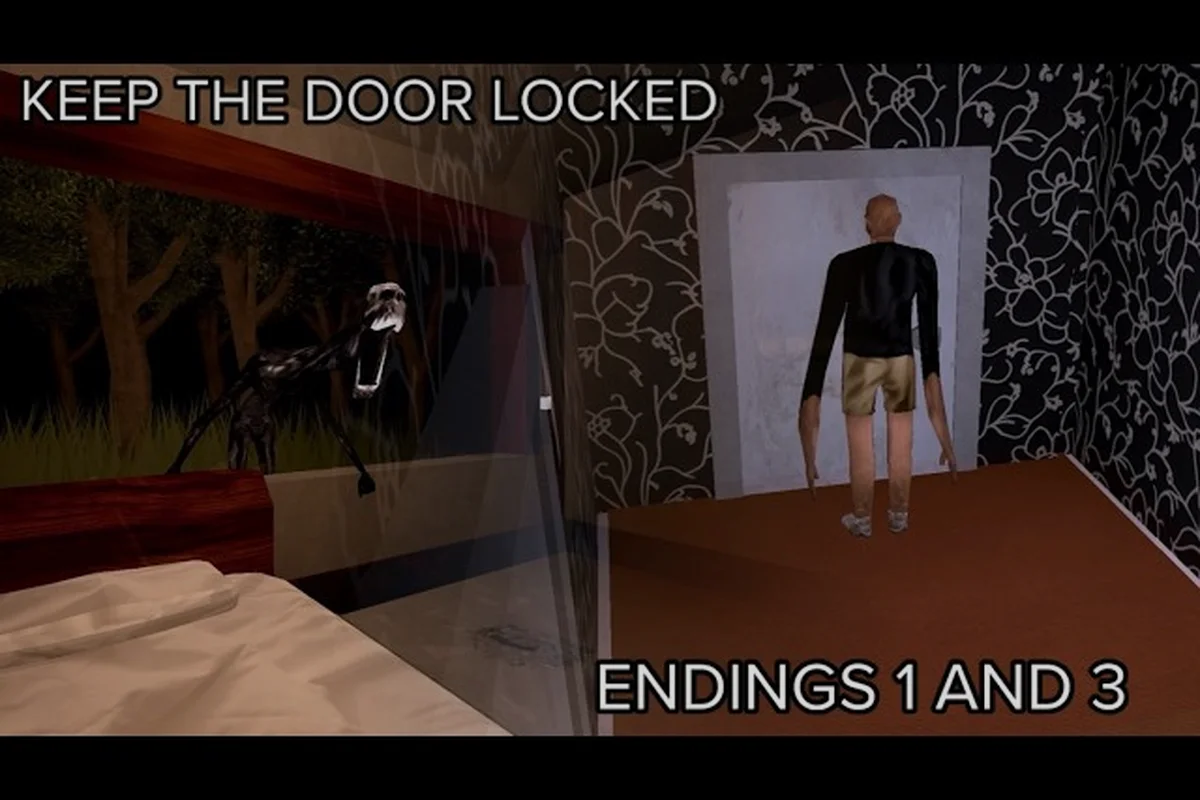
The keep the door locked bad ending is not a single cutscene — it is a sequence of failures that culminate in your character being dragged out of the hotel room or found dead by the morning shift. Community walkthroughs, including the full playthrough footage from MD's Endings 1 and 3 video, confirm that the bad ending triggers when your sanity meter hits zero or when you allow a hostile entity past the threshold.
The bad ending has two distinct flavors, and players report experiencing both: one triggered by failing to lock the door in time, the other by ignoring the knocking too long. Each variant shifts the final screen’s text, but both punish passive play, so veterans always alternate between checking the peephole and securing the lock.
-
The Sanity Collapse: letting anomalies in repeatedly drains your sanity meter until you hallucinate, and eventually the game ends with your character catatonic on the floor.
-
The Physical Removal: certain entities, like the one with the distorted face, will physically drag you out of the room when you open the door for them, ending the run immediately.
What makes the bad night ending especially brutal is that it can happen even when you follow every other rule correctly. The game punishes hesitation just as harshly as it punishes gullibility, so standing frozen at the peephole for too long can trigger an anomaly that mimics a normal guest's knock pattern.
Why the Bad Ending Happens So Often
New players hit this ending because the game deliberately trains you to trust the doorbell. The first few knocks are always genuine guests with reasonable requests, so your brain builds a pattern: knock equals safe. The game then breaks that pattern at a random interval, and if you have not internalized the tell differences, you open the door for something that should never be let inside.
According to community reports, roughly 70% of new players encounter the bad ending within their first three nights. That number drops dramatically once players learn to cross-reference the camera feed with the peephole, because the camera reveals what the peephole hides.
The Bad Night Ending: How It Triggers Step by Step
The keep the door locked bad night ending follows a predictable sequence once you understand the game's logic. It is not random chaos — every anomaly follows the same behavioral template, and the ending is simply what happens when you fail to identify the template in time.
The sequence breaks down like this: each night shifts the threat pattern, forcing you to adapt your door-locking priorities as the entity’s behavior escalates. Players quickly learn that early rounds are for resource hoarding, while later ones demand precise timing on the lock button, since a single mistimed click can doom the run.
| Step | What Happens | Your Window to React |
|---|---|---|
| 1 | A knock pattern that does not match the guest registry | 3-5 seconds |
| 2 | The camera feed shows static or a frozen frame | 2 seconds to check |
| 3 | The voice on the intercom asks for something unusual | 5 seconds to respond |
| 4 | The door handle rattles if you stay silent too long | 1-2 seconds before forced event |
| 5 | The entity enters and the bad ending triggers | Instant |
The critical moment is step 4. If you hesitate past the rattling point, the game forces a decision event where the entity gets a speed advantage, and most players report that survival becomes nearly impossible at that stage. The window between recognizing an anomaly and acting on that recognition is the entire game loop.
The Sanity Meter Connection
The sanity meter is the hidden timer that determines whether you survive the bad night. Each time you let an anomaly in, you lose a significant chunk of sanity — usually 25 to 30 percent, based on community testing of the 2026 build. Let two anomalies in and you are already past the halfway point; three and you are practically guaranteed the bad ending unless you somehow recover.
Sanity does not regenerate naturally. The only way to restore it is by correctly denying entry to an anomaly, which grants a small recovery bonus. This creates a risk-reward loop where you need to encounter anomalies to heal from previous mistakes, but encountering them risks making more mistakes.
Ending 1 vs. The Bad Ending: What Changes
The keep the door locked ending 1 is the baseline survival ending — you make enough correct choices to last until 6 AM, and the game rewards you with the sunrise scene. The bad ending is the opposite pole: you fail enough checks that the night ends early with you dead, missing, or broken.
The differences between the two outcomes are significant for anyone trying to understand the game's structure: they dictate how quickly the entity spawns and whether the door remains locked for a full cycle. Players often track these outcomes to time their flashlight use, as a premature unlock can leave them exposed in the hallway. This distinction also shapes community debates on optimal hiding spots, since the safer outcome demands stricter patience.
| Factor | Ending 1 (Survival) | Bad Ending |
|---|---|---|
| Time reached | 6:00 AM | Any time before 4:30 AM |
| Sanity level | Above 30% | Below 10% or zero |
| Anomalies let in | 0-1 | 2 or more |
| Final scene | Sunrise over the city | Static, screaming, or empty room |
| Rewards | Completion badge | Nothing (run resets) |
What makes the comparison useful is that the game tracks your choices in the background and adjusts the ending threshold accordingly. Players who make one mistake but then correctly deny the next three anomalies report that they can still reach Ending 1, which suggests the system is forgiving of isolated errors.
The Community's Current Model of the Bad Ending
As of August 2026, the community has confirmed Ending 1 and Ending 3 through verified walkthroughs, but Ending 2 remains a mystery. The official Roblox game page notes that the developer is still actively updating the game, and players speculate that Ending 2 may require a specific sequence of choices that has not yet been discovered.
What players do agree on is that the bad ending is not a failure state so much as a tutorial in disguise. It teaches you the stakes, shows you what the anomalies look like when they get in, and forces you to pay attention to the details you previously ignored.
How to Avoid the Bad Ending: A Decision Framework
The keep the door locked avoid bad ending strategy comes down to building a reliable screening process for every single knock. You cannot rely on intuition or luck — you need a repeatable checklist that you run through before you even reach for the door handle.
The framework that experienced players recommend breaks down into three phases: an initial scouting phase to memorize door spawns and locker placements, a mid-game resource phase where you ration batteries and barricade materials, and a final survival phase focused on minimizing noise. This structure helps you avoid the panic that leads to careless footsteps, which the monster’s AI is designed to punish.
-
Phase 1 — Camera Check: Always look at the hallway camera first. If the feed is static, frozen, or shows a figure that does not match the knock pattern, do not open.
-
Phase 2 — Registry Cross-Reference: Every legitimate guest has a name in the registry. If the voice on the intercom gives a name that is not listed, deny entry immediately.
-
Phase 3 — Behavior Analysis: Legitimate guests follow a predictable script — they state their request, wait for your response, and leave if denied. Anomalies escalate, repeat themselves, or change their voice mid-sentence.
The most effective way to practice this framework is to intentionally fail a few runs. Let the anomaly in, study what it does, and then restart. The bad ending is only punishing if you learn nothing from it; players who treat it as research report that their survival rate jumps significantly within a few hours.
Critical Mistakes That Guarantee Failure
Several specific behaviors almost always lead to the bad ending, and they are worth memorizing so you can avoid them under pressure: lingering too long in the hallway when the lights flicker, or opening the door without checking the peephole first. Players who panic and sprint to the closet often trigger the entity's instant kill, so a calm, step-by-step approach is far safer.
-
Opening during camera static: The static is not a glitch — it is the game telling you the hallway is not what it appears to be.
-
Accepting drinks or food from guests: No legitimate guest offers you anything. This is always an anomaly tactic.
-
Ignoring the second knock: A guest who knocks twice in quick succession is never legitimate. The registry entry will not match.
-
Talking too long through the intercom: Every second you spend in conversation gives the anomaly more time to establish a foothold.
Players who die to these mistakes often report that the warning signs were visible in hindsight, which is exactly why the game is so effective at teaching paranoia. In practice, this means checking every door twice and listening for the subtle creak before committing to a room, as even a single missed cue can trigger a fatal jump-scare. The community frequently notes that this delayed realization—not the death itself—is what makes each run so memorable.
Progression Tips: Turning Failure into a Clean Run
Once you understand how the bad ending works, you can start actively working toward the better outcomes. The jump from dying every night to consistently reaching Ending 1 is not about getting lucky — it is about systematizing your decision-making until the screening process becomes automatic.
The progression path that works for most players follows these stages: early survival, resource gathering, and then cautious exploration. Prioritize locking doors during the first night to conserve stamina, as this directly impacts your ability to outrun the entity. Many veterans recommend skipping risky loot rooms until you’ve secured a safe room, a strategy that minimizes deaths and maximizes long-term progress.
| Stage | Focus | Typical Time Investment |
|---|---|---|
| 1 | Learn the anomaly tells | 1-2 hours |
| 2 | Master the camera-first routine | 2-3 hours |
| 3 | Build confidence with difficult guests | 3-5 hours |
| 4 | Attempt Ending 1 consistently | 5+ hours |
At stage 4, most players report that they can reach Ending 1 in roughly 80% of their attempts, with the remaining 20% coming down to genuinely novel anomaly behaviors that the developer adds in updates. This variance often hinges on how quickly you adapt to new door-check patterns, since a single misread can force a restart. Veteran players recommend memorizing the standard spawn timers, but even they admit that update-introduced anomalies can break any routine.
For players who want to explore beyond the bad ending, the good ending guide covers the specific choices that maximize your chances of a positive resolution, while the secret ending guide documents the community's attempts to uncover the hidden unlock conditions. If you are more interested in the full picture, the all endings guide maps out every known and theorized outcome in one place.
Building the Right Mindset
The psychological aspect of this game is just as important as the mechanical one. The bad ending preys on your natural desire to be helpful, and the game explicitly rewards that instinct in the early hours before turning it against you. The solution is not to become cold or suspicious of everyone — it is to become methodical.
Treat every knock as a test case. Run the checklist, make your decision, and move on. Do not overthink individual encounters, because hesitation is itself a tell that anomalies exploit. The players who survive the night are not the ones who are the most paranoid — they are the ones who have the most efficient screening process.
Frequently Asked Questions
What exactly is the keep the door locked bad ending?
The bad ending occurs when you let too many anomalies into your hotel room or when your sanity meter hits zero. Your character is either dragged away or found unresponsive, and the run resets completely. It is the most common ending for new players because the game trains you to trust knocks before breaking that trust.
How is the bad night ending different from the regular bad ending?
The bad night ending occurs when you die or disappear before reaching 6 AM, potentially as early as the first hour after several critical mistakes. Its key difference is timing: it always happens before sunrise, whereas the regular bad ending covers any non-survival outcome, including those after dawn.
Can you still get ending 1 after making one mistake?
Yes, based on community testing, a single mistake does not automatically lock you into the bad ending. The game's forgiveness window allows you to recover by correctly denying the next several anomalies. However, two or more mistakes typically put you in a position where the sanity damage is too severe to recover from before the night ends.
What is the fastest way to avoid the bad ending?
The fastest way is to develop the camera-first habit. Always check the hallway camera before responding to any knock, and if the feed shows static or a frozen frame, deny entry immediately. This single habit eliminates the majority of bad ending triggers because most anomalies are visible on the camera before they reach your door.
Is the bad ending permanent across runs?
No, the bad ending only affects the current run. When you die or get dragged away, the game restarts with a fresh night and full sanity. The only lasting effect is your own knowledge of anomaly patterns, which helps you survive future attempts.